
The owner's table
I remember at one startup I was working with, the CEO insisted on joining every demo of his product. Three years into the company’s life he was still on every customer call. He saw this practice as a “unique differentiator” in the cybersecurity space. He told me so himself: “there aren’t any other cybersecurity startups out there where the CEO joins every customer call!”
This is true. And there’s a reason for it.
After speaking with the support team, I confirmed what I already surmised: almost every customer asked to speak with the CEO whenever they had a technical problem that needed to be escalated.
Guess how many of those escalations he had time to join.
Why founders stay in the seat
The actual timing when a founder or executive needs to transition away from day-to-day customer calls is a moving target, but generally, a founder should not be running demos past an initial funding round if the company has any hopes of scaling. After a funding round, a founder’s responsibilities naturally start to shift toward long-term strategy and growth planning versus day-to-day business operations, and in my experience, this can be a rocky transition. By definition, founders like what they’ve built, and they enjoy working on it and telling people about it.
A founder already has a ton to manage at this stage. They’re likely still heavily involved in engineering, but also fundraising and finance, board meetings, marketing, hiring, conferences, interviews, thought leadership, and a million other things the founder of a cybersecurity company is responsible for. Software sales is a very involved process that requires diligent focus over time and follow-through. Asking a founder to be an integral part of the sales process not only pulls them away from the critical responsibilities of running the company, it also does the sales process a disservice by injecting a resource that simply can’t be available to help when needed.
By running the demos, the founder effectively becomes the SE. In enterprise cybersecurity software sales, all the elements of a deal orbit around the SE, so if that SE is distant or removed from the equation the whole system breaks down.
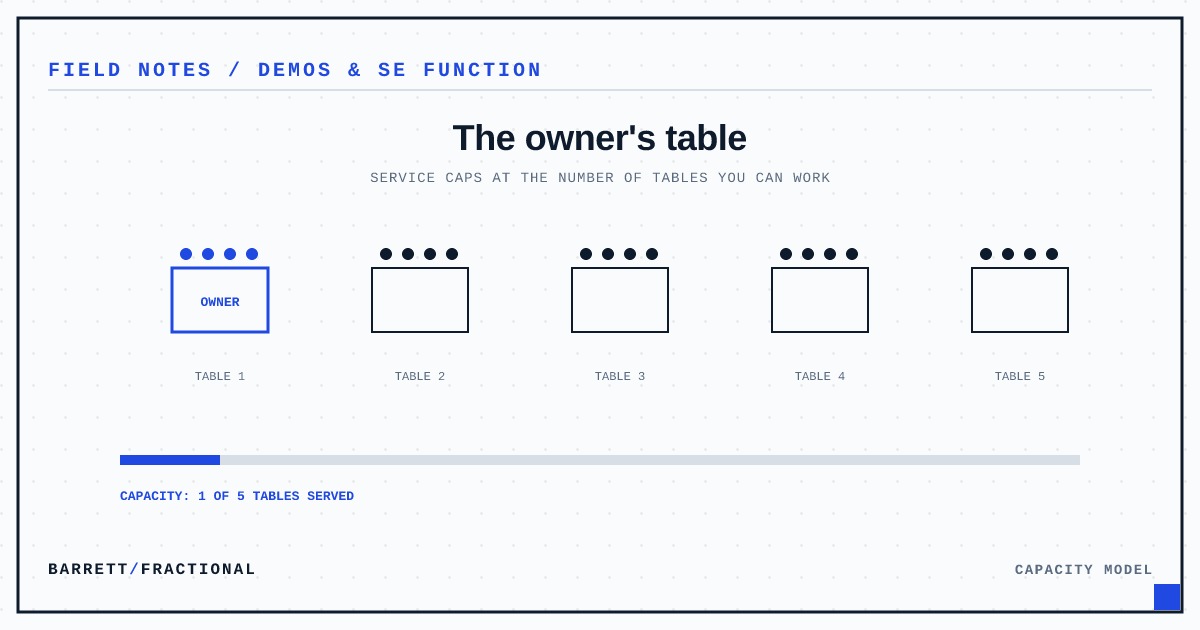
The owner’s table
There’s an analogy I like to use to illustrate this point. Let’s say there’s a couple, and they become regulars at a neighborhood restaurant. One night, on a whim, the owner comes out and personally serves their table. He checks on the wine and suggests a different bottle, sends out a dish that isn’t on the menu, tells a story about where the recipe came from, and asks the couple if they think he should add it to the menu. It’s a genuinely memorable night. The couple has a great time, feeling very important and cared for.
A few weeks later, the couple is back at the restaurant and their order comes out wrong. The waiter apologizes, offers to make it right immediately, and comps the incorrect dish. The error is handled well, with normal, even generous service recovery. But the couple doesn’t want the waiter. They ask for the owner. The owner isn’t there that night, and as a result the couple doesn’t get that “VIP” feeling.
From then on, the couple only goes to the restaurant if the owner is there and can serve them personally.
Here’s the thing: the owner didn’t do anything the staff wasn’t already trained to do. But now, to the couple, anything short of the owner feels like being handed off to someone who doesn’t really matter, even though the wait staff went above and beyond when there was an issue.
Ultimately, it’s a worse outcome for the couple because they are no longer satisfied with the service, and a worse outcome for the staff, who are perfectly capable of helping the couple (possibly even more so), but aren’t given the opportunity.
The fallout
This is not to say that a founder or executive should never join a call. Oftentimes it’s a boon for a deal to have company higher-ups join to talk about the vision, demonstrate oversight, or other business-heavy, low-tech topics. In the analogy above, there would have been no problem for the owner to make an appearance to ensure the couple was enjoying their experience, but being served by the owner indirectly gave the couple the idea that real service only happens from the top, and everyone else in the building is more of a placeholder until he’s available. Every founder-run demo teaches that same lesson, and everyone in the deal learns it at the same time.
What the customer expects. By leveraging the founder as a central resource on sales-process calls, two things are guaranteed to happen. One: the customer is going to have a problem, and the founder is not going to be available to assist due to other commitments. Two: the customer will grow accustomed to getting access to the founder, setting the post-sales relationship up for failure.
A founder has the ability to say and do things that senior staff cannot: talking roadmap, promising features, giving discounts. This may seem well and good in the moment, but once the founder is no longer available, it greatly degrades the staff’s ability to assist the customer. The longer a founder (or any executive for that matter) is acting as the SE, the more customers go through the pipe expecting founder-access whenever they have a problem, and the more headaches will manifest in the post-sales world.
How your team feels. In a healthy business, sales pipelines grow, deals get faster, and sales teams fall into rhythms. Nothing disrupts a rhythm like an executive joining a call. Imagine having a chat with your friends as a kid, and a teacher or parent walks into the room. What happens to the conversation? It’s not that there’s any ill will coming from the authority figure, but when a CEO or founder joins a call, their mere presence drastically alters the vibe. AEs who generally take risks to advance deals become more conservative. SEs who would ask a hard, potentially deal-stopping question to verify a deal’s legitimacy hold back. Even customers may be a bit more cavalier in their asks if they know the big boss is listening.
What happens to the pipeline. Scheduling a founder for a demo becomes increasingly difficult over time. The gaps where an AE can sneak an hour on a founder’s calendar become few and far between. One AE I worked with told me his founder had three two-hour blocks reserved for demos each week, but by the time he was able to schedule a customer, those blocks had all been booked. He could never find a timeslot in the same week he got the customer on the phone for the first time. It may not sound like much, but momentum holds weight in sales, and time kills all deals.
What the founder learns. As a founder grows into more executive responsibilities, they naturally become more out of touch with the daily operations of their business. Startups move fast, and things change quickly. If something isn’t working and someone comes up with a better idea, that idea becomes the thing. It’s one of my favorite things about startups, but it can drastically change the sales dynamic, and thus cause havoc for a founder who is “out of the loop”.
Signals
Is “founder-dependence” capping your sales motion right now? A few things to look for:
Support escalations ask for you by name. Customers have learned that real service only happens from the top, and everyone else is a placeholder until you’re available.
Your AE can’t book a demo in the same week they hooked the customer. Your calendar has become the constraint on the pipeline, and time kills all deals.
The vibe changes when you join a call. AEs get conservative, your technical people hold back the hard questions, customers get more cavalier in their asks. Your presence is altering deals rather than advancing them.
A customer had a problem this month and you weren’t available. This is guaranteed to happen, and each time it does, it confirms to the customer that they need you specifically.
Deals feel like they only move when you’re in the room. You’ve become the restaurant owner, and the motion is capped at the number of tables you can personally serve.