
Yellow lights
During an engagement a few years back, I started to shadow a deal that was forecasted to close by the end of that month. The SE informed me that the evaluation was nearing the end and things were looking positive.
I shadowed a POC check-in call that afternoon. It was a relatively straightforward call, the testers were engaged, but I was hearing a lot of “oh, we didn’t get to that yet” or “that’s on the list, but we have to contact the admin for access”, and “we’ll do that next week.”
There was no urgency. Earlier the AE had told me this was forecasted in commit for the end of the month. After listening to the testers’ responses I sensed a mismatch in timing. Closing a deal rarely happens the same day an eval completes, and we were already more than halfway through the month.
At the end of the call I asked the SE to confirm the eval complete date.
“It sounds like testing is going well,” he said, “are we still on track to have this done in time for a purchase to be made by the end of the month?”
I gave the SE a tip-of-the-hat for that one, great question.
There was a pause, then the lead tester chimed in and said “We should be able to get the testing done, let me get back to you in the next few days to confirm.”
The SE nodded. I pinged him over chat “Ask, what happens if you don’t choose a product by the end of this month.”
He hesitated, then asked the question. The tester’s response said it all:
“Nothing, really.”
After the call, the AE immediately pulled it from his commits.
Yellow lights
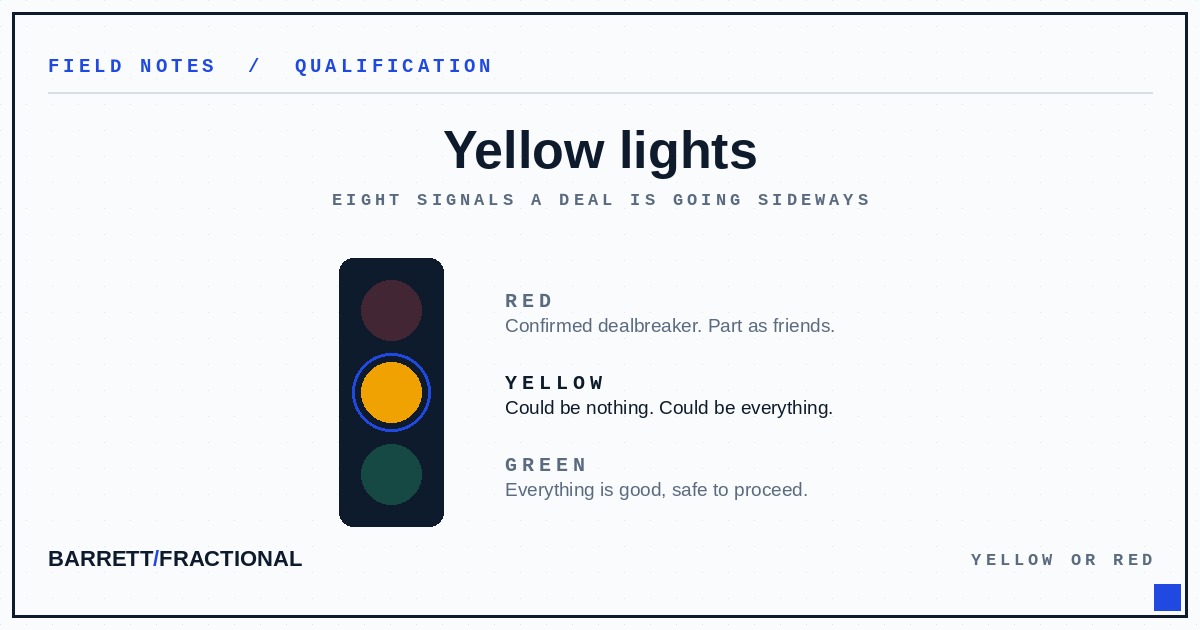
A typical traffic light at an intersection on any road, anywhere in the world is going to have three colors: green, yellow, and red. Green means everything is good, you’re safe to proceed. Red means stop immediately or you’ll run the risk of getting a ticket, or in the worst case getting in an accident. The yellow light is different, it’s up for interpretation. Am I close enough to the intersection to make the light or should I slow down? Signals encountered in a sales opportunity carry the same meaning, and as such, yellow lights are the trickiest to negotiate.
When it comes to deals, a yellow light is an objection, a missed requirement, or any other concern you have that the deal may not be progressing properly. It may be nothing, but it may also be a dealbreaker. It’s the deal itself telling you something has changed, and it shows up in predictable places: a list of requirements or an RFP, a demo kickoff, the eval criteria, and any call where the vibe doesn’t match the forecast.
Yellow lights can be anything. It can be verbal, like getting an answer to a different question than the one you asked:
“If our product meets your success criteria, will you give your technical recommendation for purchase?”
“Yea, you’re definitely in the running.”
It can be non-verbal, like a timeline that keeps getting pushed, tasks left incomplete, or an obvious preference for a competitive solution. It can even be a misunderstanding, where the customer has the impression your product has a feature that it doesn’t.
A red light is steadfast, a confirmed “dealbreaker”, the point where you cannot continue with the opportunity. No budget, no project, no timeline, your product doesn’t meet the customer’s needs… when it’s a red light, it’s obvious. Red lights get a bad rap, but they can actually be blessings in disguise because time itself has value. Being in sales, we would love to say that we can win every deal that comes across our desks but that’s just delusions and platitudes. We can’t win them all, and it’s always better to kill a deal early if you know there’s no victory in it. The question to ask yourself is “knowing what we know now, what will happen at the end of this deal if we see it through?” The whole job of a yellow light is to find red lights early so after 90 days and an unsigned quote your sales team isn’t left holding the bag.
Calling out the vibe
When talking to a customer, the vibe on the call can be a key indicator of a yellow light.
Calling out the vibe goes by many names: addressing the subtext, reading between the lines, addressing the elephant in the room, basically saying what everyone is thinking. In a sales call this can be tough, not because it’s difficult to identify, but because it can be difficult to speak out loud. It can be something as simple as asking whether your product is hitting all the success criteria and hearing “pretty much.” Or you’re in a demo and you hear “wow, this can meet almost all our needs with one product!” On the surface these seem like positive comments. On the flipside, there could be something lurking in the subtext that could crater your deal.
Why it’s worth the awkwardness
Calling out yellow lights is an essential part of the sales motion. There are several benefits, chief among which is trying to glean any unspoken issues that might be poisoning your deal. Yellow lights have the ability to expose cracks in an otherwise solid deal. It can be frustrating, especially for AEs when all of the commercial elements of a deal are in place, but without the complete picture, the deal is most likely not going to close.
The more subtle, and yet equally as important benefit is cleaning up the communication in the room. If a customer realizes that your sales team is picking up on subtle cues that may or may not indicate something bigger is going on, it will naturally tighten up responses and let the customer know that they’re paying attention.
Calling out yellow lights can be awkward, but it doesn’t have to be. The key is that it must be done. Knowing where you stand in a deal can be the difference between hitting your number or your number hitting you.
The catalog
Eight yellow lights I’ve encountered, what I initially thought each one meant, and what they might actually mean. Deals rarely announce that they’re going sideways. They do this instead.
1. The extended pause. After your SE asks a question about the eval that carries a bit of gravity, there’s a long pause before anyone answers. On the surface: your testers are genuinely grappling with the value of the question. What it might mean: nobody wants to answer, because the answer is uncomfortable.
2. The over-agreement. “Yeah, no, totally, makes sense,” with zero follow-up questions. On the surface: everybody is in solid agreement and on board. What it might mean: your testers checked out, or they’re hiding something.
3. The vague deflect. “We’ll circle back on that internally.” On the surface: they need to chat privately about something they’re not comfortable sharing with a vendor. What it might mean: they’re not evaluating your product, they’re managing you.
4. The stakeholder ghost. Someone who was in every call suddenly stops showing up. On the surface: they’re busy, called off to other tasks. What it might mean: politics are happening without you in the room.
5. The re-demo request. Instead of moving to next steps, they ask for another demo, maybe with “a few more people.” On the surface: more eyes on the product means more interest. What it might mean: the internal sell isn’t landing, and they’re stalling instead of telling you.
6. The pronoun shift. Your champion goes from “we need this” to “I like this” as the deal progresses. On the surface: a quirk, a tiny nuance, ignorable. What it might mean: internal support for your product is shrinking.
7. The timeline blur. “In a few weeks,” instead of a quarter, a date, a trigger event. On the surface: a general idea of when they want to complete, but no hard dates. What it might mean: no real deadline exists, which means no real urgency exists either.
8. The friction-free eval. No pushback, no hard questions, no objections. On the surface: feels great, smooth sailing. What it might mean: real buyers have friction. No friction usually means no real intent, or someone else is deciding and your testers already know it.
Yellow lights are missed due to momentum and hubris. Sales is hard. It’s difficult to get a prospective customer to pick up the phone, much less get a demo booked or an evaluation scheduled. Sales teams get excited about the possibility of bringing in a deal, and this has the uncanny ability to cloud judgment that would otherwise be sound. I’ve seen even the most seasoned AEs and SEs fall victim to this phenomenon, listening for what they want to hear instead of what’s actually on the table.
Yellow or red
Something has gone sideways. Is it recoverable? Have your SE call out the vibe on a call during an eval, then ask the deciding question. “Does this prevent you from making a technical recommendation for purchase?” A yellow light survives that question and strengthens the deal. A red one just saved everybody some time.